 |
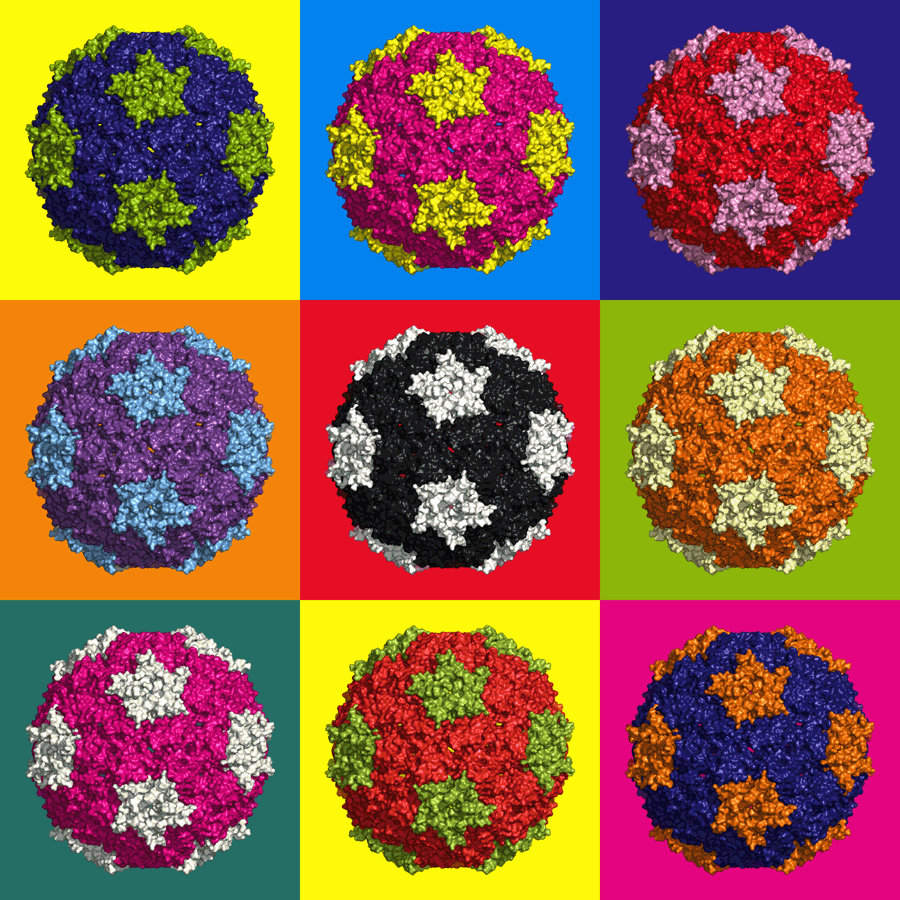
As a common feature in nature, biological macromolecules structural symmetry not only results in coding efficiency of the DNA sequence and error control in the synthesizing proteins, but also characterizes the equilibrium dynamics of the biomolecular system, and consequently it plays an essential role in defining the biological function. Coarse-grained normal mode analyses have been broadly used in recent years to elucidate the relation between structure, dynamics and function. Further insights into collective motions of the biological molecules can be gained by considering continuum models with appropriate symmetry and boundary conditions to approximately represent the molecular structure. We solved the elastic wave equation analytically for the case of spherical symmetry, yielding a symmetry-based classification of vibrational motions accessible to the structures together with explicit predictions of their vibrational frequencies.
Additionally, to understand the mechanism of functions associated with structural changes between different conformations, the transition pathways between these conformations have been explored with the help of elastic network models. A novel method, adaptive anisotropic network model (aANM), was developed for exploring the functional transitions of large biomolecular systems. Application of this model to the bacterial chaperonin GroEL, and comparisons with both experimental data and results from other theoretical and/or computational approaches such as the action minimization algorithm and Brownian dynamics simulations, support the utility of aANM as a computationally efficient, yet physically plausible tool for unraveling the potential transition pathways sampled by large complexes/assemblies. The application of this methodology to GroEL discloses how supramolecular machines exploit their structural symmetry to achieve cooperative responses. Such cooperativity is essential for the efficient transduction of signals in ATP-regulated systems such as the bacterial chaperonin GroEL.
For details of the research projects:
|
