|
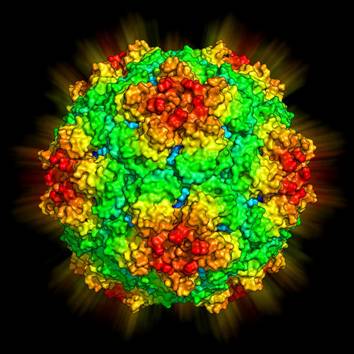
The breathing movement of satellite tobacco mosaic virus corresponding to radially directed displacements - a shrinking or swelling of the entire structure. |
In recent years, the growing numbers of studies that resort to normal mode analysis (NMA) reveal the NMA as a simple, yet physically meaningful, means of studying the dynamics of proteins under equilibrium conditions. The NMA method has been used in computational biology for more than two decades. While NMA is much more efficient than methods based on full atomic simulations, it becomes prohibitively expensive as the size of the biomolecular system increases, due to the computational cost of energy minimization at the atomic scale, as well as the eigenvalue decomposition of increasingly larger Hessian matrices.
In a previous study, we explored the utility of carrying coarse-graining to its extreme by substituting continuum models for discretized ones. A major utility of adopting a continuum model is to be able to derive analytical solutions that can reveal the basic aspects of the complex processes being investigated. Here, a continuous mass density replaced the discrete masses, elastic moduli (Young's modulus and shear modulus) replaced the springs linking the masses, and continuum elastic wave equations replaced the usual Newton's equations of motion. While the discrete Newton's equations yield a set of coupled ordinary differential equations that can be solved using matrix diagonalization, the continuum wave equation becomes a partial differential equation. Provided the material is spatially isotropic and homogeneous, the wave equation can be solved analytically.
We solved the continuum elastic wave equations for systems with spherical symmetry, exploiting the symmetry to express our solutions using the natural basis set provided by vector spherical harmonics. We compared the collective dynamics predicted for biomolecular systems using discretized models with the vibrational spectra of solid and hollow spheres. Specifically, the analytic solutions based on the continuum elastic wave equations were compared with those obtained with simple toy models based on the Mackay icosahedron and with naturally occurring supramolecular assemblies: lumazine synthase, an enzyme responsible for the synthesis of riboflavin (vitamin B2); satellite tobacco mosaic virus, one of the smallest viruses known; and a triangulation number T = 1 particle of brome mosaic virus, a virus that infects a type of grass known as bromus.
Our calculations showed that the low-lying vibrational frequencies and their associated normal modes closely follow patterns predicted by spherical symmetry and could be reproduced using a small number of parameters defined by the elasticity theory. Deviations from these predictions can be interpreted as weak perturbations that lower the spherical symmetry to icosahedral symmetry, which is naturally selected by many biological molecules. A comparison of discretized models with continuum theory of elasticity predictions permit us to assess the macroscopic mechanical properties of the examined biomolecular systems, such as their Young's moduli (normalized with respect to the elastic network force constants) and their Poisson's ratios.
Related publication: Zheng Yang, Ivet Bahar and Michael Widom (2009) Vibrational Dynamics of Icosahedrally Symmetric Biomolecular Assemblies Compared with Predictions Based on Continuum Elasticity. Biophys J 96: 4438-4448.
Download paper supplementary material
Download Mackay icosahedron coordinates
Back |