Bahaar Lab title bar


Molecular Mechanism of Dopamine Transport by Human Dopamine Transporter

Mary Hongying Cheng and Ivet Bahar  Structure (2015)


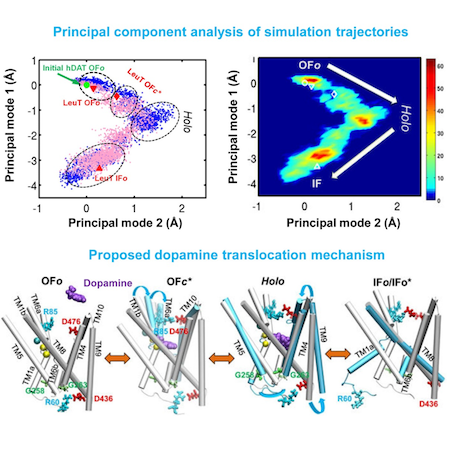
Dopamine transporter (DAT) controls neurotransmitter dopamine (DA) homeostasis by reuptake of excess DA from the synapse into the presynaptic neuron, assisted by the co-transport of two sodium ions. Malfunction of human DAT (hDAT) has been implicated in many neurological disorders. The first DAT structure (dDAT, from Drosophila melanogaster) has been recently resolved, which permit us to conduct a structure-based computational study of the time-resolved mechanism of DA reuptake by hDAT at full atomic scale. Using homology modeling and full-atomic microseconds accelerated simulation, we investigated the complete DA translocation including uptake from the EC region to its intracellular release and highlighted the key interactions that mediate DA translocation through hDAT. Our major observations are: spontaneous closure of extracellular gates prompted by DA binding; stabilization of a holo-occluded intermediate distinguished by close association of TM1b and TM6a with TM10 and resulting cluster of hydrophobic residues that prevents the hydration of the binding site; subsequent exposure to intracellular water triggered by Na2 dislocation, accompanied by a redistribution of salt bridges at the cytosolic surface; concerted tilting of TM5 and TM7, critical to opening the exit pore for substrate/ion channeling, enabled by the stretching of the G258-G263 loop, disruption of N82-N353 hydrogen bond, which drives the release of a Na+ ion and the Cl- ion; and DA release induced only after protonation of D79. Following Figure illustrates the transport mechanism, deduced from our over 13 sets micro-seconds MD simulations.

                  large protein structure


dopamine transport

Movie:

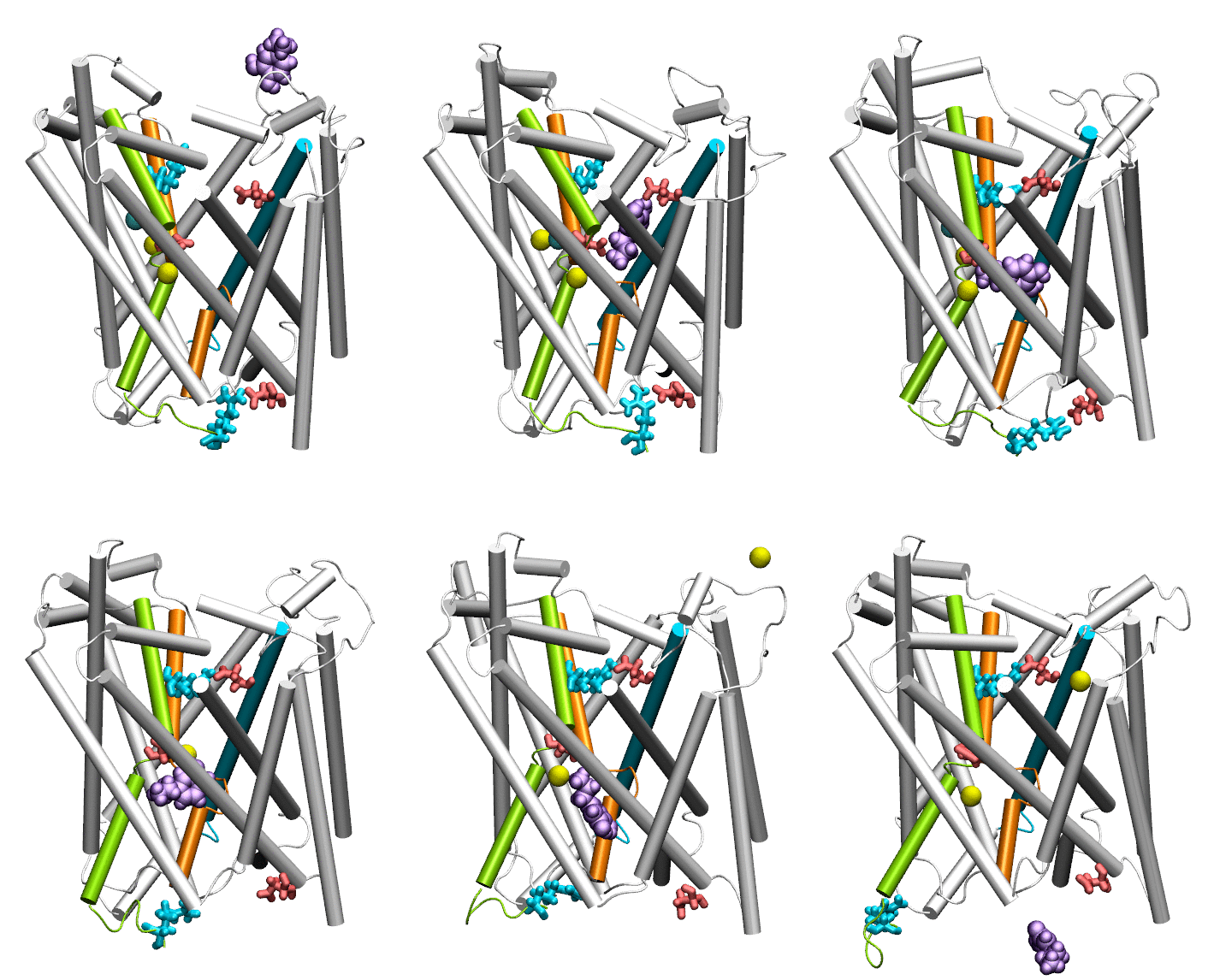
Dopamine extracellular binding, translocation, and intracellular release, captured by MD simulations.

In the movie, purple balls represent the dopamine molecule; yellow and cyan spheres the co-transported sodium and chloride, respectively. The residues forming the extracellular gate R85-D476 and intracellular gate R60-D436 are shown in cyan (basic) and red (acidic) sticks, respectively.

Highlights

  • Dopamine binding from the extracellular (EC) region prompts the closure of two EC gates

  • Intermediate state occluded to both EC and intracellular (IC) regions is identified

  • Dislocation of Na2 triggers the transition to substrate-releasing state

  • A redistribution of IC-facing salt-bridges stabilizes the inward-facing state

References:
Cheng MH, Bahar I (2015) Molecular Mechanism of Dopamine Transport by Human Dopamine Transporter Structure 23: 2171-8